How to Use AI for Meal Planning (Without Replacing Your Dietitian)
September 8, 2025
Artificial intelligence (AI) is creeping into every corner of our lives—from writing emails to generating images—and now, even meal planning. I recently spoke with The Wall Street Journal about the promise and pitfalls of using AI for planning healthy meals. As a dietitian who has spent decades helping families get dinner on the table, I see AI as a fun and sometimes useful tool, but not a replacement for professional nutrition guidance. And since September is Family Meals Month—a time to celebrate the benefits of eating together—why not hop on the AI bandwagon to make it easier to get nourishing meals on the table?
The Upside of AI in the Kitchen
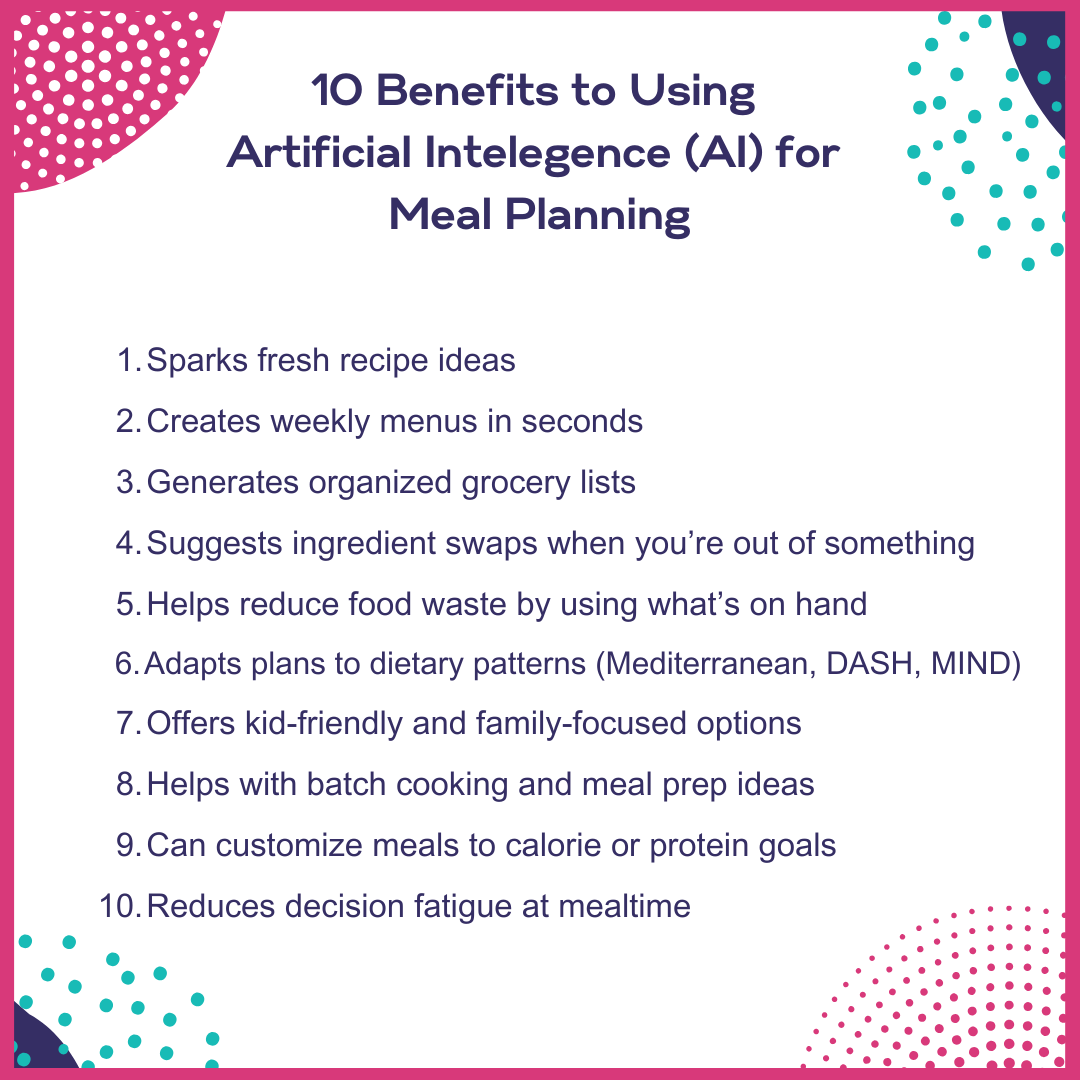
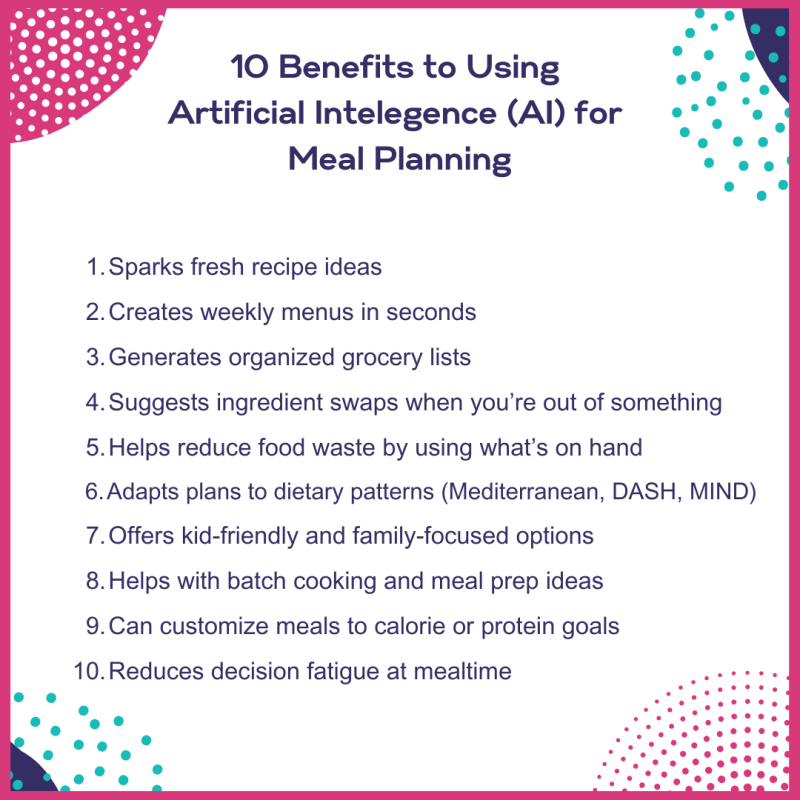
AI chatbots, like ChatGPT, can save time by generating:
- Weekly menus tailored to broad eating styles like the Mediterranean, DASH, or MIND diet.
- Shopping lists to match those menus.
- Recipe inspiration from whatever you already have in your fridge or pantry.
- Quick swaps when you’re short on ingredients (“What can I substitute for spinach in a lentil soup?”).
With the right prompts, AI can help busy individuals and families break out of a dinner rut, explore new flavors, and streamline grocery shopping.
For example, asking:
“Create a five-day dinner plan using Mediterranean diet principles, with at least 25 grams of protein per meal, each under 600 calories, and include a grocery list.”
… will generate something you can adapt to your schedule and taste.
The Limitations (Why AI Can’t Replace an RDN)
But here’s the catch: AI isn’t a registered dietitian. While it can suggest meals, it doesn’t:
- Know your medical history, goals, intolerances, or allergies.
- Always provide reliable nutrient analysis (data sources vary, and errors creep in).
- Take into account cultural traditions, budget, or cooking skills.
That’s where a dietitian steps in—to add nuance, ensure accuracy, and help turn generic suggestions into realistic, sustainable habits.
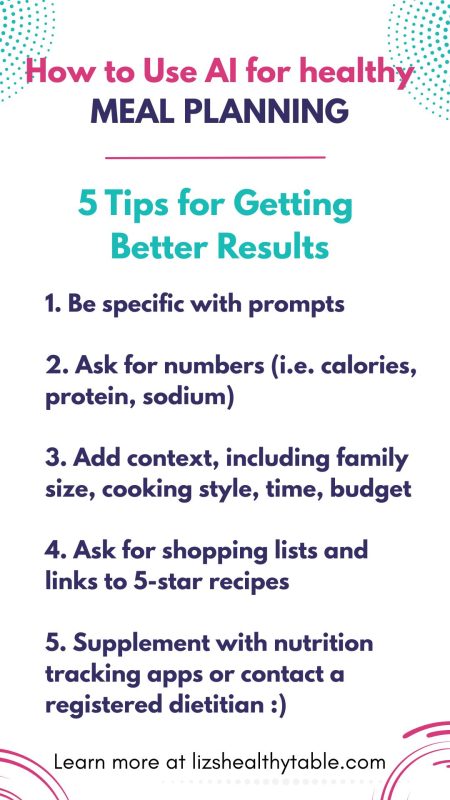
How to Write Better Prompts for AI Meal Planning
One of the biggest mistakes people make with AI is asking vague questions. The more specific your request, the more useful the response will be.
Here are some prompt-writing tips to get better results:
- Be clear about the goal. Instead of “Make me a meal plan,” try:
“Plan five dinners based on the MIND diet that are high in fiber and low in sodium.” - Include numbers. Ask for portion sizes, calories, or grams of protein, etc.
“Give me three lunch ideas with at least 20 grams of protein and under 500 calories each.” - Add context. Mention your cooking style or constraints.
“Create a three-day vegetarian plan for two adults. Meals should take under 30 minutes to prepare.” - Ask for formats. You can request bulleted lists, tables, or recipes with instructions.
“Provide a one-day high-protein meal plan in table form, including breakfast, lunch, dinner, and snacks.” - Request shopping lists.
“Generate a five-day dinner plan plus a grocery list organized by category.”
💡 Pro tip: If you don’t like the first answer, ask the AI to revise it (“Make the meals kid-friendly” or “Add more variety in vegetables”). Think of it as an iterative process.
Practical Tips to Maximize AI for Home Meal Planning
- Start with a clear, detailed prompt. Be specific about calories, meals, snacks, and portion sizes.
- Iterate and refine. Follow up with tweaks until the plan matches your needs.
- Ask for variety. Avoid monotony by telling AI not to repeat the same foods too often.
- Use AI for recipe inspiration—not recipe testing. Ask it to recommend recipes from trusted sites rather than inventing its own.
- Double-check nutrition info. Confirm estimates with USDA FoodData Central or a tracker app like MyFitnessPal.
- Use it for on-the-fly ideas. Plug in a few ingredients from your fridge, freezer, or pantry and get quick, balanced suggestions.
- Treat AI as inspiration, not gospel. Adjust results to fit your taste, pantry, and health goals.
Practical Tips to Maximize AI for Following a Specific Diet
- State your nutrient goal up front. “Create a daily plan with at least 1,000 mg calcium.”
- Use numbers, not just foods. Ask for 30 g protein at lunch or <2,400 mg sodium daily.
- Request meal-by-meal tracking. Have AI show nutrient totals for each meal.
- Ask for tested recipes. Get links from reputable food sites for reliable results.
- Get snack-specific. For example: “Suggest 10 snacks with 10–15 g protein under 200 calories.”
- Mix in real-world constraints. Ask for quick prep times or pantry-friendly options.
- Cross-check with reliable tools. Spot-check nutrients in MyFitnessPal, Cronometer, or USDA databases.
Why Nutrition Apps Still Have the Edge
While AI is great for inspiration, apps like MyFitnessPal and Cronometer still do a better job with data. They let you:
- Track vitamins and minerals that AI often overlooks.
- Scan barcodes on packaged foods for instant nutrition info.
- Upload recipes for precise analysis.
- Integrate with wearables to connect food intake with activity levels.
That’s detail AI doesn’t yet deliver consistently.
Putting It All Together
Here’s a simple workflow that combines the best of both worlds:
- Use AI for inspiration (meal ideas, themed menus like Taco Tuesday or pizza night, quick swaps).
- Cross-check those meals in an app like MyFitnessPal to confirm protein, fiber, and key nutrients.
- Adjust with the help of a dietitian to make sure the plan meets your unique needs.
The Bottom Line
Think of AI as your kitchen assistant: fast, creative, and handy for brainstorming. But when you need precision—the exact grams of protein in your lunch or the milligrams of sodium in a meal—nutrition apps and professional guidance are essential.
AI is inspiration. The apps are for the math. And when you combine both—plus the expertise of a registered dietitian—you’ll have the tools to plan meals that are not just creative and satisfying, but also realistic, evidence-based, and aligned with your lifestyle and health goals.
Healthy eating is about more than just what’s on the plate—it’s about balance, enjoyment, and supporting your healthspan for years to come.