
Thoughts on the New Dietary Guidelines for Americans — from a longevity-focused dietitian
January 7, 2026
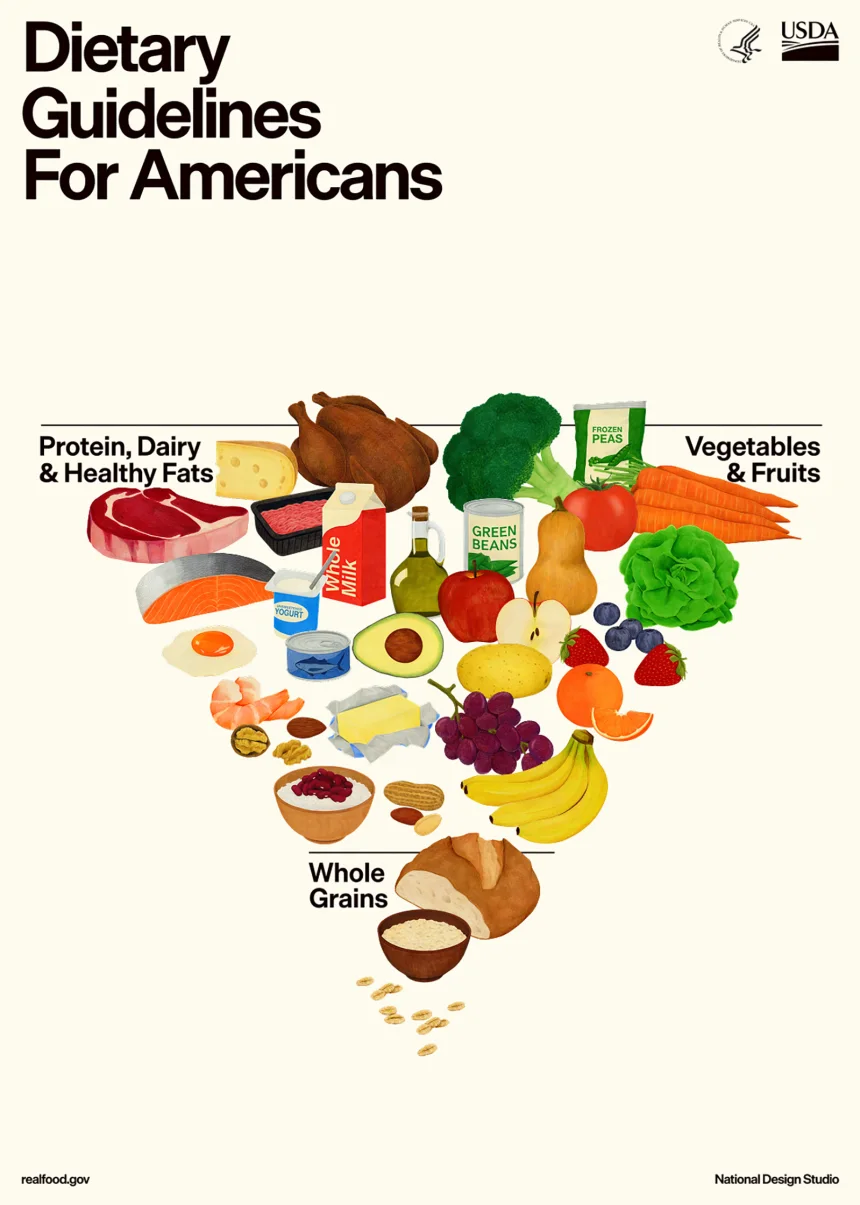
The newly released Dietary Guidelines for Americans emphasize eating real, nutrient-dense foods and focusing on overall dietary patterns rather than perfection. I appreciate that big-picture philosophy.
That said, I have concerns, especially for people trying to eat in ways that support long-term health, brain health, heart health, and a healthy planet.
Here’s what stands out to me:
1. Critiquing the pyramid — then bringing it back — creates mixed messaging
The guidelines criticize older food models like the pyramid for being overly simplistic and outdated — yet then reintroduce a pyramid-style framework. That raises an obvious question: if the pyramid was flawed, why bring it back … upside down?
At the same time, the guidelines move away from MyPlate, which — while not perfect — helped people visualize how to build a balanced meal in a practical, everyday way.
2. It’s harder to follow proven, plant-forward diets
The new framework makes it more difficult to follow dietary patterns with strong evidence for longevity, including:
- Mediterranean diet (heart health & lifespan)
- MIND diet (brain health & cognitive function)
- DASH diet (blood pressure & cardiovascular health)
These patterns consistently emphasize:
✔️ vegetables and fruits
✔️ whole grains
✔️ legumes
✔️ nuts and seeds
✔️ olive oil
✔️ limited saturated fat
Those principles are less clearly supported in the new visual guidance.
3. Fiber is encouraged — but without clear targets
The guidelines encourage people to “eat more fiber,” yet do not include specific daily fiber goals, such as the well-established recommendation of ~25 grams per day for women and ~38 grams per day for men.
At the same time:
- Whole grains are limited to ~2–4 servings per day
- Beans and legumes are not clearly highlighted
This makes it challenging for most people to meet fiber needs — even though fiber is strongly linked to heart health, gut health, blood sugar control, and longevity.
4. Heavy emphasis on red meat and full-fat dairy raises concerns
The guidelines place a strong emphasis on red meat, full-fat dairy, butter, and even beef tallow.
These foods are:
- High in saturated fat, which research consistently links to higher LDL cholesterol and increased cardiovascular risk when consumed in excess
- Calorie-dense, which can make it harder to manage weight and energy balance over time
From a longevity and cardiometabolic health perspective, this emphasis feels at odds with dietary patterns that consistently show benefits for heart health and lifespan.
PS: The new guidelines still advise limiting saturated fat to less than 10% of daily calories, yet visually elevate foods highest in saturated fat, including red meat, full-fat dairy, butter, and beef tallow. Without clearer guidance on portions and frequency, this mixed messaging may leave consumers unsure how to meet the stated recommendation.
5. Alcohol guidance is vague
Previous guidelines included clear limits — up to 1 drink per day for women and up to 2 for men. The new guidance removes specific limits, which may leave people unclear about how to reduce alcohol-related health risks over time.
6. The ‘no added sugar for kids’ message isn’t realistic
Reducing added sugar is important. But a zero-sugar message for children:
- isn’t realistic for most families
- may create confusion or guilt
- risks undermining sustainable, balanced eating habits
My bottom line
As a dietitian who values flavor, affordability, sustainability, and what people can actually stick with, I believe dietary guidance should be:
- clearer
- more actionable
- and better aligned with the strongest evidence for long-term health
I’ll continue guiding people toward eating patterns that support living longer and better.
Helpful resources:
Adherence to a Mediterranean dietary pattern — rich in fruits, vegetables, whole grains, legumes, nuts, and olive oil — has been linked to significant reductions in cardiovascular events and mortality in both randomized trials and prospective cohort studies.
Estruch et al., New England Journal of Medicine; Sofi et al., American Journal of Clinical Nutrition (PMC)
Dietary patterns similar to the DASH and Mediterranean diets are associated with lower all-cause mortality and improved markers of cardiometabolic health when compared with higher-saturated-fat, lower-fiber diets.
Frontiers in Nutrition
Higher dietary fiber intake is linked to lower risk of heart disease, stroke, type 2 diabetes, colorectal cancer, and overall mortality in large systematic reviews and meta-analyses, supporting fiber targets in the range of ~25–38 grams per day.
Reynolds et al., The Lancet, 2019 (PMID: 30733359)
Emerging evidence suggests that plant-forward dietary patterns may also be associated with healthier aging and reduced chronic disease burden across the lifespan.
Nature Medicine